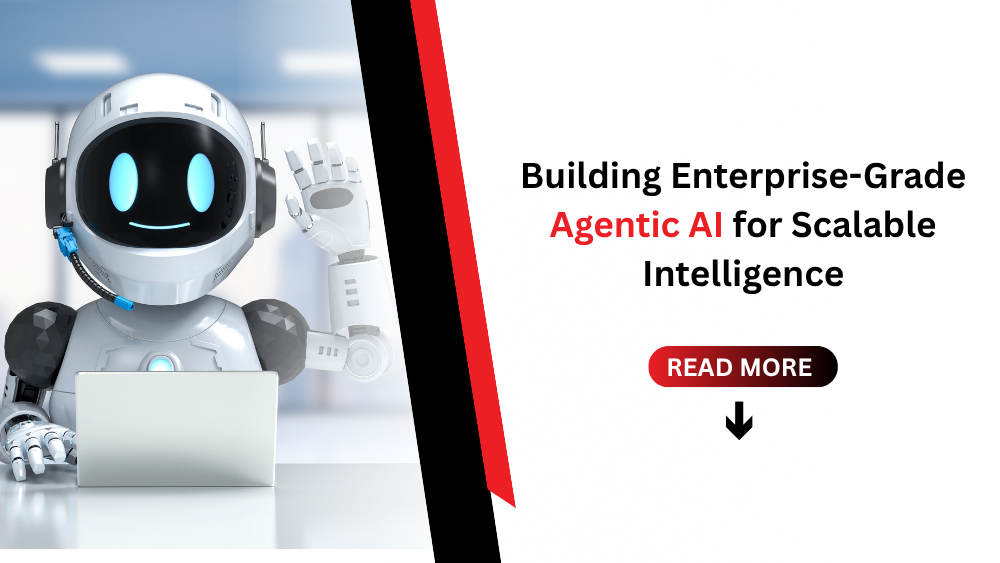
Every industry is now exploring the next leap in intelligent automation. After years of experimenting with chatbots and workflows, enterprises are entering a phase where systems do more than respond. They reason, take initiative, learn from outcomes and work across business functions. This shift is defined by Agentic AI, an approach where AI systems behave as capable operators, not passive assistants.
For forward-looking enterprises, Agentic AI is not a trend. It is the foundation for scalable intelligence and long-term competitiveness.
Why Agentic AI is Becoming a Strategic Imperative
Modern enterprises run a web of applications, data sources and business processes. Efficiency today depends on more than digital tools. It depends on intelligence that can navigate complexity, collaborate with humans and operate responsibly within enterprise boundaries.
Agentic AI fits that need because it can plan, act and self-improve without waiting for constant human instruction. Instead of automating one task at a time, it connects processes, takes initiative when conditions change and ensures continuity even in dynamic environments.
This evolution is reshaping the way organizations think about scaling knowledge and decision-making across the enterprise. It brings automation to a strategic level, where intelligence becomes part of business architecture, not a plug-in capability.
The intent behind enterprise-grade Agentic AI is simple – give systems the ability to operate with judgment while staying aligned to organisational policies and objectives.
Where assistive models respond to requests, Agentic AI systems
- Understand goals and context
- Break down work into actionable steps
- Execute tasks across systems
- Monitor outcomes and refine actions
- Collaborate with people where input is needed
In this model, AI agents work alongside teams to drive efficiency, reliability and innovation.
The Architecture Behind Enterprise-Ready Agentic AI
Delivering intelligence at scale requires more than clever models. It demands structure, control and alignment to enterprise standards. Successful architectures typically include:
Foundation for knowledge and skills
Agents must access data responsibly, apply business rules, and use the skills relevant to their role whether it is processing requests, generating insights or driving operational workflows.
Clear operating structure
Well-defined agentic frameworks establish responsibilities, escalation paths and collaboration rules. This ensures agents work in coordination rather than isolation.
Integrated execution environment
Agents need seamless connectivity to business systems. Whether they are writing entries, updating records or orchestrating tasks, interaction across enterprise systems must be secure and governed.
Governance and traceability
Every action should be auditable, compliant and transparent. Enterprise adoption thrives when intelligence operates within standards rather than outside them.
Scalability and extensibility
As needs evolve, the organisation should be able to introduce new agents, expand use cases and build capability without redesigning the core system.
These pillars allow agentic AI to move from innovation labs to mission-critical environments.
Real-World Enterprise Scenarios
Adoption is accelerating because leaders are seeing tangible, business-aligned outcomes. Consider these examples where agentic AI proves valuable
Service operations
Agents monitor service queues, route requests, trigger actions in operational systems and notify stakeholders by helping teams maintain service levels even during demand spikes.
Finance and risk
Agents retrieve data, validate inputs, prepare submissions and highlight exceptions to support precision and compliance-driven operations.
Supply chain and manufacturing
Agents track material flows, detect bottlenecks, trigger procurement decisions and help maintain continuity across regions and time zones.
Each example shows intelligence becoming an active operator, not merely an advisor.
Strategic Path for Enterprises
Building scalable Agentic AI is a journey, not a single deployment. Successful organizations typically follow a structured approach to
- Identify priority domains where autonomy yields measurable value
- Pilot thoughtfully with real workflows and success benchmarks
- Design the agentic framework that defines roles and collaboration
- Establish governance and risk controls from day one
- Expand gradually across functions, guided by results
- Build a centre of excellence to institutionalise capability
This ensures innovation scales responsibly and sustainably.
Enterprise-Level Value Creation
When agents operate with reliability and governance, enterprises benefit across multiple dimensions of
- Faster execution cycles
- Stronger consistency in process outcomes
- Improved workforce productivity
- Greater operational resilience
- Enhanced quality of insights
Capabilities grow, teams focus on higher-value initiatives, and technology becomes a force multiplier for business performance.
Platforms like Agentforce are emerging to support this model, combining operational control, integration capabilities, and enterprise security for AI-driven systems. Adoption will continue as enterprises recognise that scalable intelligence requires both innovation and discipline.
Conclusion
Enterprise adoption of agentic AI is not only a technology milestone, but also a capability shift. As organisations move beyond automation and toward intelligent systems that can reason, act and adapt, success will depend on disciplined architecture, responsible deployment and a clear vision for scale. When executed with governance and purpose, agentic AI strengthens operational reliability, accelerates decision-making and enables teams to focus on strategic priorities rather than repetitive work.
In this next phase of digital maturity, the competitive advantage will belong to enterprises that build intelligence into the core of their operating model not only as a tool, but also as an active and accountable contributor to business outcomes. The journey requires foresight, structured experimentation and cross-functional collaboration, but the outcome is transformative a future where intelligence is embedded, scalable and aligned to enterprise value.